TL;DR: Water damage restoration in the Las Vegas Valley typically runs $1,800 to $12,000 for most residential jobs. The biggest cost drivers are the category of water involved (clean, gray, or sewage), how many square feet are affected, and how long the water sat before extraction started. Insurance usually covers sudden, accidental losses but excludes slow leaks and deferred maintenance. Every job gets a written scope before work begins.
You came home to wet carpet, a soaked ceiling, or standing water in a room that should be dry. Now you’re trying to figure out what this is going to cost before you call anyone. That’s a smart instinct. The range on water damage restoration is genuinely wide, and knowing what moves the number helps you read an estimate, talk to your adjuster, and avoid getting overcharged.
How Much Does Water Damage Restoration Cost in the Las Vegas Valley?
Most residential water damage restoration jobs in Henderson, Las Vegas, and the surrounding valley cost between $1,800 and $12,000. Small, clean-water losses caught quickly land at the low end. Larger jobs involving contaminated water, saturated structural materials, or secondary mold growth push toward the high end or beyond.
Here is a breakdown by common scenario:
| Scenario | Typical Las Vegas Valley Range |
|---|---|
| Single room, Category 1 (clean water), caught within 24 hours | $1,200 - $3,500 |
| Two to three rooms, Category 1, hardwood or tile affected | $3,000 - $6,500 |
| Category 2 (gray water, e.g. washing machine overflow, toilet supply line) | $3,500 - $8,500 |
| Category 3 (black water, sewage, or floodwater with contaminants) | $5,000 - $15,000+ |
| Whole-floor or multi-room loss with structural drying needed | $7,000 - $14,000 |
| Crawl space or subfloor saturation | $2,500 - $6,000 |
These are typical industry figures for this region, not a quote or guarantee. Every loss is different, and a written scope based on actual moisture readings is the only reliable number for your specific job.
What Factors Drive the Final Price?
Four variables account for most of the spread between a $1,500 job and a $12,000 job.
Water category. The IICRC S500 standard classifies water losses into three categories. Category 1 is clean water from a supply line or appliance. Category 2 is gray water with some contamination, like a washing machine drain or dishwasher overflow. Category 3, also called black water, includes sewage backups, toilet bowl overflows, and any water that has been standing long enough to grow bacteria. Category 3 requires full PPE, antimicrobial treatment, and disposal of porous materials that cannot be safely dried in place. That adds significant labor and material cost.
Square footage affected. Restoration companies price by the square foot for drying, antimicrobial application, and content manipulation. A 200-square-foot bathroom loss and a 1,400-square-foot ground floor loss are not in the same ballpark.
How long the water sat. Water that sits for more than 24 to 48 hours begins wicking up drywall, saturating insulation, and creating conditions for mold growth. The EPA notes that mold can begin developing within 24 to 48 hours of a moisture event. A job that could have been a straightforward extraction and dry-out becomes a partial demolition and rebuild if the response is delayed.
Materials affected. Drying a tile floor is faster and cheaper than drying hardwood, engineered wood, or carpet over a concrete slab. Saturated drywall often has to come out. Insulation almost always does. Cabinets and built-ins add scope. The more porous the materials and the more layers involved, the longer the drying cycle and the higher the cost.
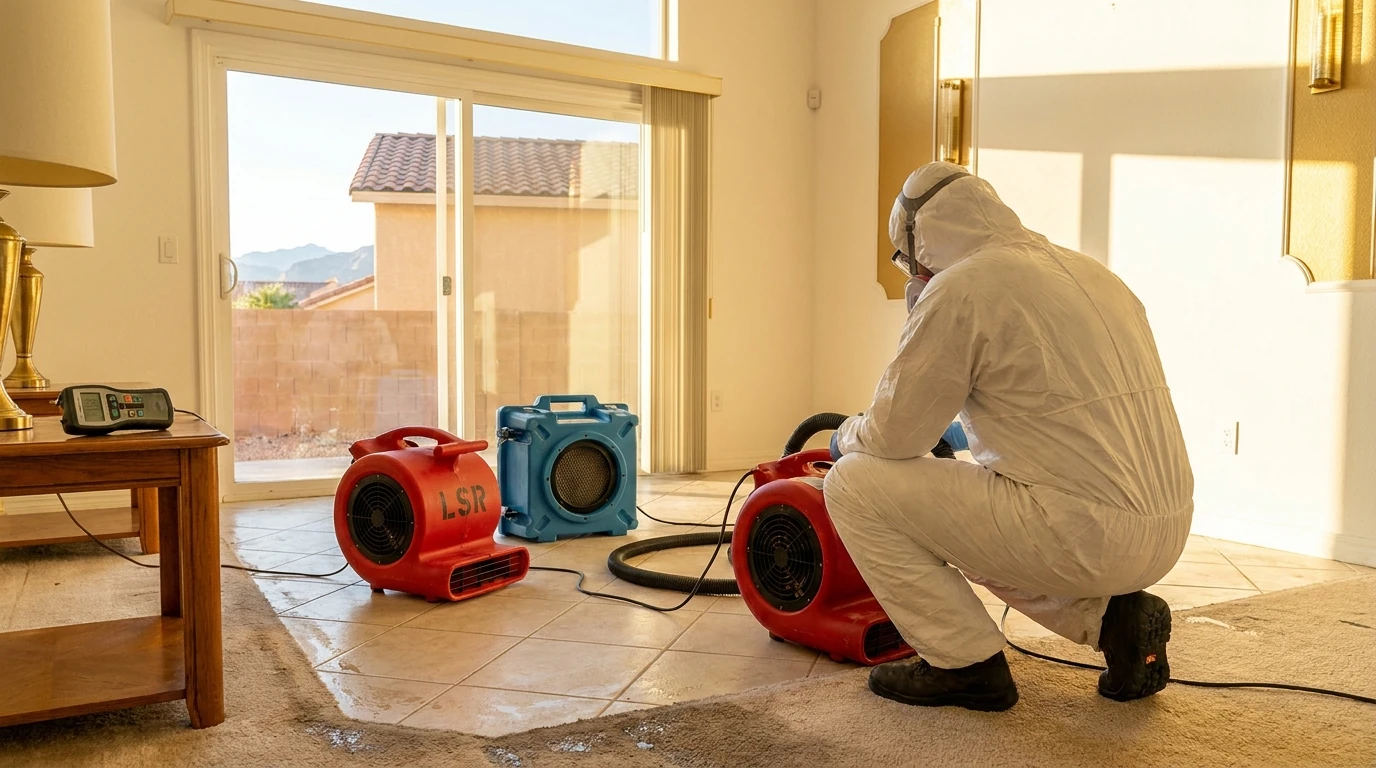
Equipment and drying time. A standard residential dry-out uses air movers (typically one per 50-100 square feet of affected area), low-grain refrigerant (LGR) dehumidifiers, and daily moisture monitoring. The IICRC S500 standard defines drying goals by material class. Reaching those goals in a Nevada climate, which is dry but hot in summer, generally takes three to five days. Longer drying cycles mean more equipment days and more monitoring visits.
Does Insurance Cover Water Damage Restoration?
Most standard homeowners policies cover sudden, accidental water damage but exclude gradual leaks, flooding, and deferred maintenance. The distinction matters because it determines whether your insurer pays the restoration bill or you do.
Covered scenarios typically include burst pipes, appliance failures (washing machine hoses, water heater ruptures), and sudden roof leaks from storm damage. Not covered under most HO-3 policies: slow leaks behind walls, slab leaks that developed over time, sewer backup (unless you have a rider), and any flooding from outside the structure (that requires a separate NFIP or private flood policy).
For a deeper look at what policies actually cover, see our post on does homeowners insurance cover water damage.
A few things that protect your claim:
- Document before extraction starts. Photos and video of the standing water, wet materials, and affected contents. Do this before anyone moves anything.
- Get a written scope of work. A legitimate restoration company provides a line-item estimate tied to Xactimate or a similar industry pricing tool. That document is what your adjuster reviews.
- Keep the damaged materials. Do not throw out wet drywall, flooring, or contents until your adjuster has seen them or given written approval to dispose.
- Report promptly. Most policies require timely reporting. Waiting days to call your insurer can complicate or reduce your claim.
For more on navigating the first hours after a loss, the burst pipe emergency checklist covers the immediate steps before the restoration crew arrives.
What Does the Restoration Process Actually Look Like?
Knowing the phases helps you understand what you are paying for and what each line item on an estimate represents.
- Emergency extraction. Truck-mounted or portable extractors remove standing water. This is billed by the hour or by the square foot and is usually the first line on any estimate.
- Moisture mapping. Technicians use thermal imaging cameras and penetrating moisture meters to find where water has traveled inside walls, under flooring, and into structural cavities. This determines the full scope.
- Controlled demolition (if needed). Saturated drywall is cut to the flood cut line (typically 12 to 24 inches above the waterline). Flooring, insulation, and cabinets that cannot be dried in place are removed and documented for the claim.
- Drying system setup. Air movers and LGR dehumidifiers are placed per the drying plan. In a Las Vegas summer, ambient temperatures above 100 degrees can actually accelerate surface drying but also push humidity into wall cavities, so equipment placement matters.
- Daily monitoring. A technician visits each day to take moisture readings, adjust equipment, and document progress. Drying is complete when materials reach their dry standard per the IICRC S500, not just when things feel dry to the touch.
- Antimicrobial application. Applied to affected surfaces after drying to inhibit mold growth. Required on Category 2 and 3 losses; often recommended on Category 1 jobs where drying took longer than 48 hours.
- Final documentation. A drying report with daily readings, equipment logs, and photos. This goes to your insurer and protects you if a mold question comes up later.
If mold is already present when the crew arrives, that becomes a separate scope. See our post on black mold vs regular mold for what to expect if testing comes back positive.
What Should You Do Right Now?
If water is still entering the structure, stop the source first. Shut off the main water supply or the isolation valve for the affected fixture. If you cannot stop it, call a plumber before calling a restoration company. Once the source is controlled, the restoration clock starts.
Call your insurer to open a claim, then call a restoration company to begin extraction. You do not have to wait for adjuster approval to start mitigation. Most policies require you to take reasonable steps to prevent further damage, and delay makes the loss worse and the claim harder.
For water damage in Henderson and across the Las Vegas Valley, Life Savers Restoration LLC is available 24/7 at (702) 845-1325. Their IICRC-certified crews handle extraction, structural drying, and full documentation for insurance claims. You can also request an assessment online.
For a comparison of local restoration companies serving Henderson, see The 5 Best Water Damage Restoration Companies in Henderson, NV.
About Life Savers Restoration LLC
Life Savers Restoration LLC is an IICRC Certified Firm based in Henderson, NV (license 0091001), serving the Las Vegas Valley since 2019. Their technicians hold IICRC certifications in Water Damage Restoration (WRT), Applied Structural Drying (ASD), and Mold Remediation (AMRT), among others. The company handles water damage restoration, mold remediation, fire damage restoration, storm damage restoration, sewage cleanup, biohazard cleanup, and contents restoration. They are available 24/7 for emergency response across Henderson, Las Vegas, North Las Vegas, and surrounding communities.
Video Transcript
You came home to wet carpet or standing water and your first question is: what is this going to cost me? Let’s break it down clearly. Most water damage jobs in Henderson and Las Vegas run between eighteen hundred and twelve thousand dollars. That wide range depends on a few key factors. The biggest factor is water category. Clean water from a supply line costs the least. Gray water from a washing machine costs more. Sewage backup is the most expensive to clean safely. Square footage matters a lot. A wet bathroom and a soaked ground floor are completely different jobs, and priced that way. Time is critical. After twenty-four to forty-eight hours, water soaks into drywall and mold can start growing. A fast response keeps the job smaller and cheaper. Materials matter too. Tile dries faster than hardwood. Saturated drywall usually has to be removed. The more layers involved, the longer and costlier the dry-out. Most homeowners insurance covers sudden accidental damage, burst pipes, appliance failures. It usually does not cover slow leaks or flooding. Document everything before work starts. Professional restoration crews use air movers and dehumidifiers to reach safe drying goals. Most jobs take three to five days of active drying with daily moisture checks. Want an honest estimate for your home? Call Life Savers Restoration LLC at seven oh two, eight four five, thirteen twenty-five for a free assessment today.