Mold Remediation in Henderson
24/7 mold remediation in Henderson and surrounding areas. IICRC-certified, insurance billing accepted. Call (702) 845-1325.
You might notice it first as a faint, earthy smell behind a bathroom wall, or as a dark stain spreading along the grout line of a shower that was never quite dry after a slow leak. Mold doesn’t announce itself the way a burst pipe does. It colonizes quietly, often inside wall cavities and under flooring where it’s invisible for weeks, and by the time the discoloration is visible on a surface, the colony behind it is typically far larger than what you can see. That’s the problem mold remediation exists to solve: not just wiping away what’s visible, but eliminating the source and verifying the air is clean.
What mold remediation actually involves
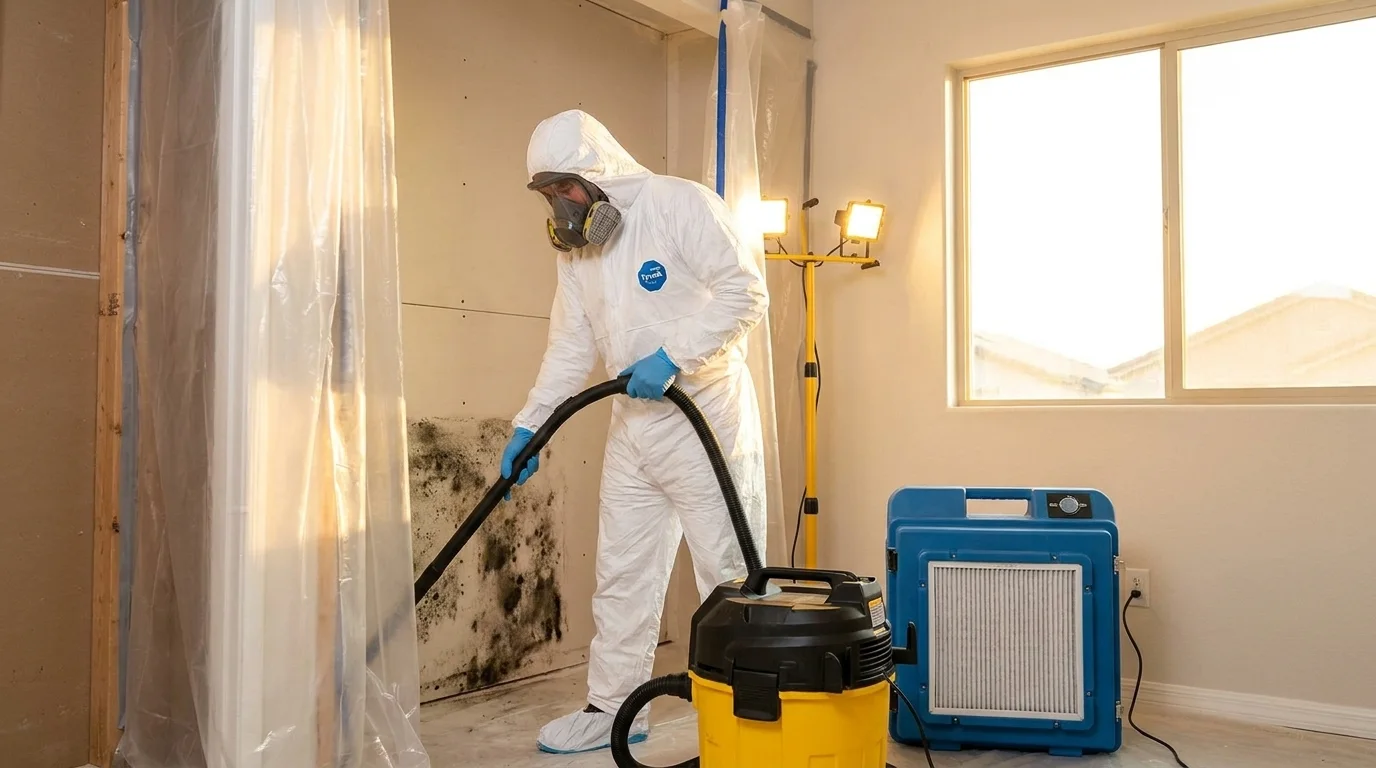
Mold remediation is a structured, multi-phase process, not a cleaning job. The goal is to physically remove contaminated materials, control airborne spore counts, and return the space to a condition where mold cannot immediately recolonize. That requires specialized equipment: HEPA-filtered negative air machines that draw contaminated air out of the work zone, industrial HEPA vacuums, moisture meters, and thermal imaging cameras to locate hidden moisture reservoirs that would feed a new colony if left untreated.
Timeline varies by the size and severity of the affected area. A single bathroom with surface mold and an identifiable moisture source might be resolved in one to two days. A crawl space with widespread growth, or a home where a slow plumbing leak saturated wall cavities across multiple rooms, can take several days of active remediation plus a waiting period before clearance testing. The IICRC S520 standard, the industry protocol our AMRT-certified technicians follow, governs how each phase is executed, from initial containment through final air sampling.
Our process
-
Inspection and moisture mapping. Before any material is removed, technicians use moisture meters and thermal imaging to trace the moisture source and define the full extent of growth, including areas where mold is present but not yet visible. Skipping this step is the single most common reason mold returns after remediation. If you’re still deciding whether you even have a problem, our guide to home mold testing walks through DIY kits versus a professional inspection and when each is worth it.
-
Containment setup. Affected areas are isolated with poly sheeting and negative air pressure so that disturbing the mold during removal doesn’t spread spores to unaffected parts of the home. For larger or more severe losses, full critical barriers with zipper-door entry points are established per IICRC S520 guidelines.
-
Removal of contaminated materials. Porous materials, drywall, insulation, carpet, wood framing in some cases, that are colonized beyond surface level are removed and bagged for disposal. Non-porous surfaces are HEPA-vacuumed and treated with an EPA-registered antimicrobial agent.
-
HEPA air scrubbing. Negative air machines with HEPA filtration run continuously during and after removal to capture airborne spores released during demolition. This phase continues until spore counts in the work area are within acceptable limits.
-
Clearance testing. A post-remediation verification, typically air sampling sent to an independent laboratory, confirms that spore counts inside the remediated area are comparable to outdoor baseline levels. Life Savers Restoration LLC provides documentation of clearance results, which your insurance carrier and any future buyer’s inspector may request.
What separates a good mold response from a bad one
The most common failure in mold remediation is treating the symptom without resolving the source. Painting over discoloration or applying a surface biocide to visible mold without identifying and correcting the underlying moisture problem guarantees the colony returns, often worse, because the disruption spreads spores to new surfaces.
A second frequent mistake is inadequate containment. Mold spores are microscopic and travel easily through HVAC systems and doorways. Remediation performed without proper negative air pressure and poly barriers can cross-contaminate rooms that were previously clean, turning a localized problem into a whole-home issue.
Insurance adjusters and industrial hygienists reviewing a claim will look for documentation at every phase: pre-remediation moisture readings, a written scope of work, photographic evidence of containment and material removal, and a third-party clearance report. Remediation that lacks this paper trail can complicate or delay claim settlement. Our team is IICRC AMRT certified, EPA Lead-Safe certified (relevant in older Henderson homes where disturbing walls may involve lead-based paint), and OSHA trained, and we produce the documentation adjusters expect.
What does mold remediation cost?
Typical costs depend heavily on the size of the affected area, the type of materials involved, and whether the moisture source requires repair before remediation can begin. Most homeowners pay somewhere in the ranges below for professional mold abatement, these are industry-typical figures, not a quote from Life Savers Restoration LLC.
| Scenario | Typical industry range |
|---|---|
| Single bathroom, surface mold, identifiable source | $500 – $1,500 |
| Single room, mold in drywall and insulation | $1,500 – $4,000 |
| Crawl space mold remediation | $2,000 – $6,000 |
| Multi-room loss, wall cavity involvement | $4,000 – $10,000 |
| Whole-home or severe HVAC-spread contamination | $10,000 – $30,000+ |
Every loss is different, and Life Savers Restoration LLC provides a written scope of work before any remediation begins so you know exactly what is included. Homeowners insurance coverage for mold varies significantly by policy, coverage is more likely when the mold results directly from a covered peril (like a sudden pipe burst) and less likely when it stems from long-term humidity or a maintenance issue, so reviewing your policy language early matters.
Seasonal and regional considerations
Henderson’s desert climate is drier than most of the country, but that doesn’t make homes immune to mold. The risk concentrates around specific conditions: monsoon-season moisture intrusion through improperly sealed stucco or flat roofs, evaporative cooler pads that stay damp between uses, and, critically, the aftermath of any water damage that isn’t dried completely within 24 to 48 hours. In a climate where relative humidity can spike dramatically during summer storms after months of arid conditions, building materials that absorb moisture during a leak may not release it as readily as homeowners expect, especially inside wall cavities insulated with fiberglass batts.
Service area
Life Savers Restoration LLC is based in Henderson and provides mold remediation throughout the Las Vegas Valley, including Boulder City, North Las Vegas, Summerlin, and surrounding communities. Individual city-specific pages are linked from the service area section of this site.
If you’re seeing discoloration, detecting an unexplained musty odor, or recently had a water loss that wasn’t professionally dried, call (702) 845-1325 to request an air quality assessment. Our AMRT-certified team is available around the clock, because mold doesn’t wait for business hours, and neither do we.
Services We Handle
- Applied Microbial Remediation
- Attic Mold Removal
- Basement Mold Removal
- Bathroom Mold Removal
- Black Mold Removal
- Certified Mold Remediation
- Crawl Space Mold Removal
- Emergency Mold Removal
- Mold Cleaning
- Mold Damage Restoration
- Mold Detection
- Mold Inspection
- Mold Mitigation
- Mold Removal and Remediation
- Mold Removal Behind Walls
- Mold Testing
- Mold Treatment
- Water Damage Mold Inspection
- Water Damage Mold Removal
Frequently Asked Questions
Does homeowners insurance cover mold remediation?
What level of mold contamination requires full containment with negative air pressure?
What's the difference between black mold and other mold types, and does it change how remediation is done?
What should I do — and not do — while waiting for the remediation team to arrive?
What is clearance testing and is it required after mold remediation?
Looking for the best mold remediation company in Henderson?
Life Savers Restoration LLC provides licensed and insured mold remediation in Henderson, NV and the surrounding area, and has served local property owners since 2019. Customers rate us 4.8 out of 5 stars across 246 Google reviews. We answer calls 24/7 — call (702) 845-1325 for immediate help.
Need Mold Remediation now?
We respond 24/7 across Henderson and surrounding NV cities.
Related Coverage
- Our Restoration Services
- Contact Life Savers Restoration LLC
- Mold Remediation in Boulder City
- Mold Remediation in Enterprise
- Mold Remediation in Las Vegas
- Mold Remediation in North Las Vegas
- Mold Remediation in Paradise
- Mold Remediation in Spring Valley
- Mold Remediation in Sunrise Manor
- Mold Remediation in Whitney
- How To Choose a Restoration Company in Henderson (Without Getting Burned)
- How To Test for Mold in Your Home (DIY Kits vs a Pro Inspection)
- 7 Signs You Have Hidden Mold (and What To Do Next)