24/7 Emergency Water Damage Restoration in Henderson
24/7 emergency water damage restoration in Henderson and surrounding areas. IICRC-certified, insurance billing accepted. Call (702) 845-1325.
Water damage emergency in Henderson? We answer 24/7. Call now and our crew heads out to stop the water and start drying your property.
Water you can see is only part of the problem. Within the first hour of a pipe burst, appliance failure, or roof intrusion, water is already moving, wicking into drywall, traveling under flooring, and pooling inside wall cavities where no fan will ever reach it. The visible puddle on your kitchen floor is the easy part. What’s saturating the subfloor beneath it, and the bottom plate of the wall behind the dishwasher, is what turns a containable loss into a mold problem three weeks from now.
What Water Damage Restoration actually involves
Water damage restoration is not mopping up and running a few fans. At its core, it is a controlled drying science, measuring moisture content in building materials, calculating the vapor pressure gradient between wet assemblies and the air around them, and using calibrated equipment to pull that moisture out before it causes secondary damage.
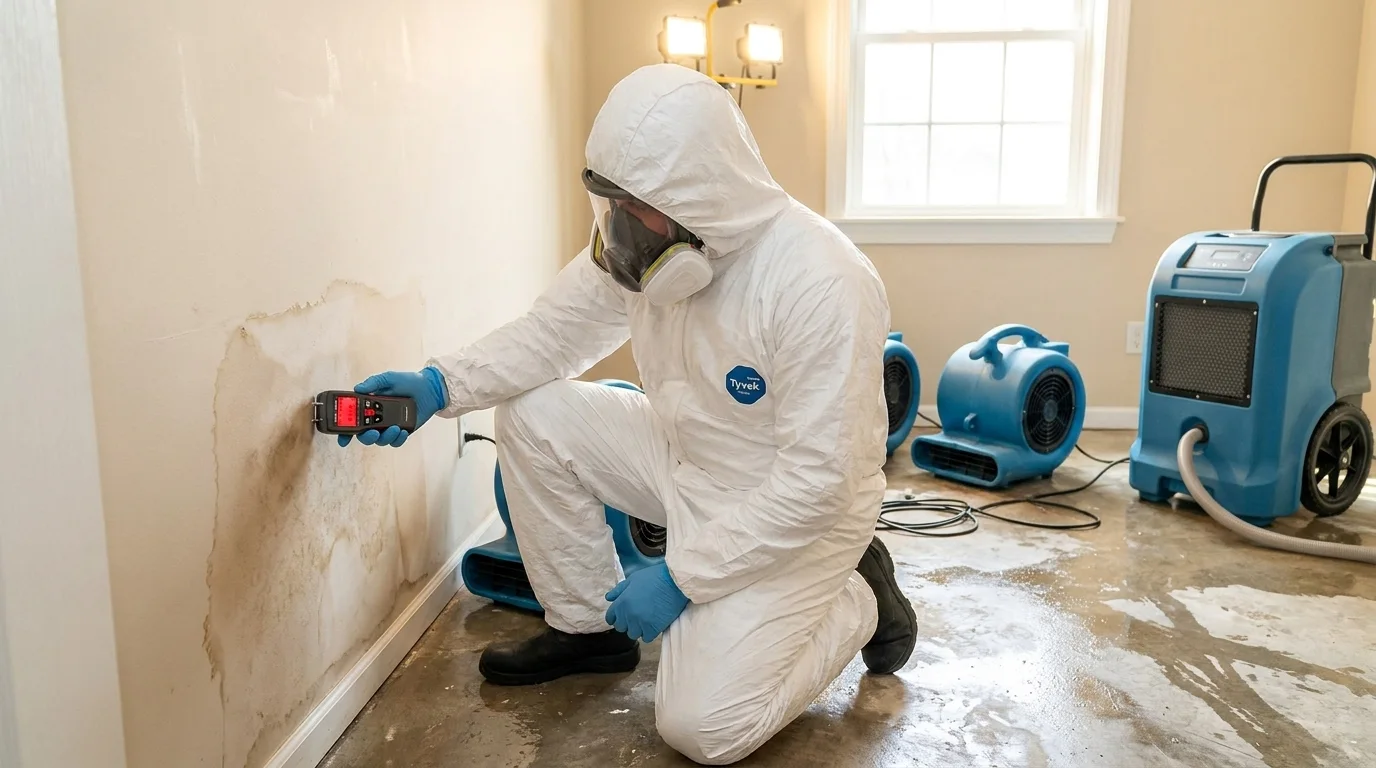
The equipment matters. Truck-mounted or portable extractors remove standing water and pull moisture from carpet and pad. Low-grain refrigerant (LGR) dehumidifiers drop the dew point in the work area so wet materials can release moisture into the air. Air movers create high-velocity airflow across surfaces to accelerate evaporation. Desiccant dehumidifiers are used in harder-to-dry assemblies or when ambient conditions make refrigerant units less effective. Thermal imaging cameras and penetrating moisture meters map the true boundary of the loss, not just where the floor feels soft, but where the moisture has actually traveled.
Timeline matters just as much as equipment. The IICRC S500 standard, the industry benchmark for water damage response, recognizes that materials left wet beyond 24–48 hours enter a window where microbial growth becomes likely. Structural drying typically takes three to five days under normal conditions, though Category 2 or 3 losses, affected building assemblies, and Henderson’s dry-but-variable climate can all shift that window. Monitoring readings are taken daily to confirm drying is progressing and to document completion, not to estimate it.
Our process
-
Emergency water extraction. The first priority is removing standing water and stopping active intrusion if the source hasn’t been shut off. High-capacity extractors pull water from hard surfaces and carpet systems. The faster the water volume drops, the less migration occurs into adjacent materials.
-
Moisture mapping and category assessment. Before any drying equipment is placed, affected materials are mapped with thermal imaging and moisture meters. Water is classified by contamination level, clean water (Category 1), gray water (Category 2), or black water (Category 3), because the category determines what materials can be dried in place versus what must be removed for safety and code compliance.
-
Structural drying with daily monitoring. LGR dehumidifiers and air movers are positioned based on the moisture map, not placed at random. Readings are logged each day against the drying goal, the equilibrium moisture content for each material type. This documentation is what your insurance adjuster will want to see, and it’s what confirms the structure is actually dry rather than just surface-dry.
-
Containment and controlled demolition for Category 2/3 losses. Gray and black water carry contaminants that require a different protocol. Affected porous materials, drywall, insulation, flooring, are removed and bagged. The work area is contained to prevent cross-contamination. As an EPA Lead-Safe Certified firm, pre-1978 homes with potential lead-containing materials are handled under the additional protocols that Nevada and federal rules require.
-
Clearance verification and scope documentation. Drying is not complete until moisture readings confirm all affected materials have returned to acceptable levels. A written drying log and photo documentation are provided, the same record your carrier needs to close the claim.
What separates a good water damage response from a bad one
The most common failure in water damage work is stopping the moisture map at the visible damage. Water follows gravity and capillary action, not floor plans. It travels under baseboards into adjacent rooms, rises into wall cavities through wicking, and pools in subfloor cavities that look completely normal from above. Operators who rely on visual inspection alone miss saturation that doesn’t announce itself until mold appears.
A second common failure is premature equipment removal. Drying equipment is sometimes pulled after two days because the surface feels dry. Surface readings and deep-assembly readings are not the same. Hardwood floors, for example, can read acceptable at the surface while the subfloor beneath remains well above the drying threshold. Insurance adjusters reviewing a claim after a mold callback will look specifically at whether daily moisture logs show a complete drying curve, not just a start date and an end date.
Category misclassification is a third failure point. Water from a dishwasher drain or a washing machine overflow is Category 2, it contains biological and chemical contaminants. Treating it as clean water and drying in place without proper antimicrobial treatment is both a health risk and a liability. The source of the water determines the protocol, and that determination should be made and documented at the start of the job.
What does Water Damage Restoration cost?
Typical costs run from under $2,000 for a small, clean-water loss caught quickly to well over $10,000 for a multi-room Category 3 event requiring demolition and containment. The variables that move the number most are affected square footage, water category, how long the water sat before extraction began, and whether building materials need to be removed. Every loss is different, and Life Savers Restoration LLC provides a written scope before work begins so there are no surprises mid-project.
| Scenario | Typical industry range |
|---|---|
| Single room, clean water (Category 1), caught within hours | $1,200 – $3,500 |
| Single room, gray water (Category 2), partial demolition needed | $2,500 – $6,000 |
| Multi-room loss, clean water, hardwood or engineered flooring affected | $4,000 – $9,000 |
| Crawl space or subfloor saturation | $3,000 – $8,000 |
| Sewage backup or black water (Category 3), containment required | $5,000 – $15,000+ |
| Whole-floor event, Category 2/3, demolition and drying combined | $10,000 – $25,000+ |
Homeowners insurance typically covers sudden and accidental water losses, a burst pipe, an appliance failure, or storm-driven intrusion, but generally excludes gradual leaks and flood events (which require separate flood coverage through the NFIP or a private carrier). Life Savers Restoration LLC works directly with all major carriers and documents the loss to the standard adjusters expect.
Seasonal and regional considerations
Henderson sits in the Mojave Desert, which creates a counterintuitive set of water damage risks. The dry air accelerates surface evaporation, which can mask ongoing moisture in wall assemblies and give a false impression that things are drying on their own. They often aren’t, the vapor pressure gradient that pulls moisture out of deep assemblies depends on controlled conditions, not just low outdoor humidity.
The monsoon season, typically July through September, brings intense short-duration rainfall that Henderson’s drainage infrastructure and the region’s hardpan soils are not always equipped to absorb quickly. Flat or low-slope roofs common in the area, block construction, and stucco exteriors all have specific vulnerabilities during these events. Block walls wick moisture differently than wood-frame walls, and the drying protocols need to account for that. Winter cold snaps, infrequent but real in the Las Vegas Valley, can freeze exposed supply lines in uninsulated garages and attic spaces, producing burst-pipe losses that arrive without warning.
Service area
Life Savers Restoration LLC is based in Henderson and provides water damage restoration throughout the greater Las Vegas Valley, including Las Vegas, North Las Vegas, Boulder City, Summerlin, and surrounding communities. Service-area-specific pages cover local details for each city.
If your floors are wet, your walls are damp, or you’ve just shut off a water source and aren’t sure how far the damage has traveled, the next step is a moisture assessment, not a guess. Call Life Savers Restoration LLC at (702) 845-1325 to schedule yours.
Services We Handle
- Appliance Leaks
- Carpet Water Damage
- Carpet Water Extraction
- Ceiling Water Damage Repair
- Commercial Restoration
- Flood Damage
- Flood Restoration
- Hardwood Floor Water Damage
- Laminate Floor Water Damage
- Water Damage Cleanup Repair
- Water Damage Repair
- Water Damage Under Flooring
- Water Leak Detection
- Water Mitigation
- Wet Carpet
- Wet Carpet Drying
- Wet Drywall Repair
- Wood Floor Water Damage Repair
Frequently Asked Questions
Does homeowners insurance cover water damage restoration?
How long does structural drying typically take after water damage?
What is the difference between Category 1, 2, and 3 water damage, and why does it matter for cleanup?
What should I do — and not do — while waiting for the restoration crew to arrive?
Can water damage behind walls or under flooring be dried without tearing everything out?
Watch: Water Damage Restoration in Henderson
Looking for the best water damage restoration company in Henderson?
Life Savers Restoration LLC provides licensed and insured water damage restoration in Henderson, NV and the surrounding area, and has served local property owners since 2019. Customers rate us 4.8 out of 5 stars across 246 Google reviews. We answer calls 24/7 — call (702) 845-1325 for immediate help.
Need Water Damage Restoration now?
We respond 24/7 across Henderson and surrounding NV cities.
Related Coverage
- Our Restoration Services
- Contact Life Savers Restoration LLC
- 24/7 Emergency Water Damage Restoration in Boulder City
- 24/7 Emergency Water Damage Restoration in Enterprise
- 24/7 Emergency Water Damage Restoration in Las Vegas
- 24/7 Emergency Water Damage Restoration in North Las Vegas
- 24/7 Emergency Water Damage Restoration in Paradise
- 24/7 Emergency Water Damage Restoration in Spring Valley
- 24/7 Emergency Water Damage Restoration in Sunrise Manor
- 24/7 Emergency Water Damage Restoration in Whitney
- Burst Pipe Emergency Checklist: Step-by-Step Response
- What To Do in the First 24 Hours After Water Damage
- How To Choose a Restoration Company in Henderson (Without Getting Burned)