24/7 Emergency Fire Damage Restoration in Henderson
24/7 emergency fire damage restoration in Henderson and surrounding areas. IICRC-certified, insurance billing accepted. Call (702) 845-1325.
Fire damage emergency in Henderson? We answer 24/7. Call now and our crew heads out to secure the property and start the recovery.
The fire is out, but the damage isn’t done. In the hours after a house fire, soot continues to etch into porous surfaces, acidic smoke residue corrodes metal fixtures, and the smell of combustion works its way deeper into drywall, insulation, and HVAC ductwork. What looks like surface discoloration on day one can become permanent staining by day three. Fire and smoke restoration is a race against secondary damage, and it requires a very different skill set than simply cleaning up debris.
What Fire Damage Restoration actually involves
Fire damage is rarely just fire damage. A single residential fire typically produces at least three distinct problems that have to be addressed in sequence: structural damage from heat and flames, smoke and soot contamination that spreads far beyond the burn area, and water damage from suppression efforts. Restoration crews have to work all three at once.
Soot is not uniform. Fires burning wood and drywall produce a dry, powdery residue that brushes off surfaces relatively easily. Fires involving synthetic materials, carpet, upholstery, plastics, wiring insulation, produce a wet, oily soot that smears on contact and bonds chemically to painted walls, cabinetry, and glass. Protein fires (kitchen grease, food) leave an almost invisible film that carries an intense odor and requires enzymatic or alkaline cleaners to break down. Identifying the soot type before touching anything determines which cleaning agents and methods get used. The wrong choice, scrubbing dry soot with a wet cloth, for example, drives contamination deeper into the substrate.
Beyond soot, smoke travels. In a two-story home, smoke migrates through wall cavities, returns, and supply ducts into rooms that never saw flames. Restoration technicians use thermal imaging and air sampling to map contamination before scoping the work. IICRC FSRT-certified technicians are trained specifically in fire and smoke restoration, including the chemistry of combustion byproducts and the behavior of smoke in a structure.
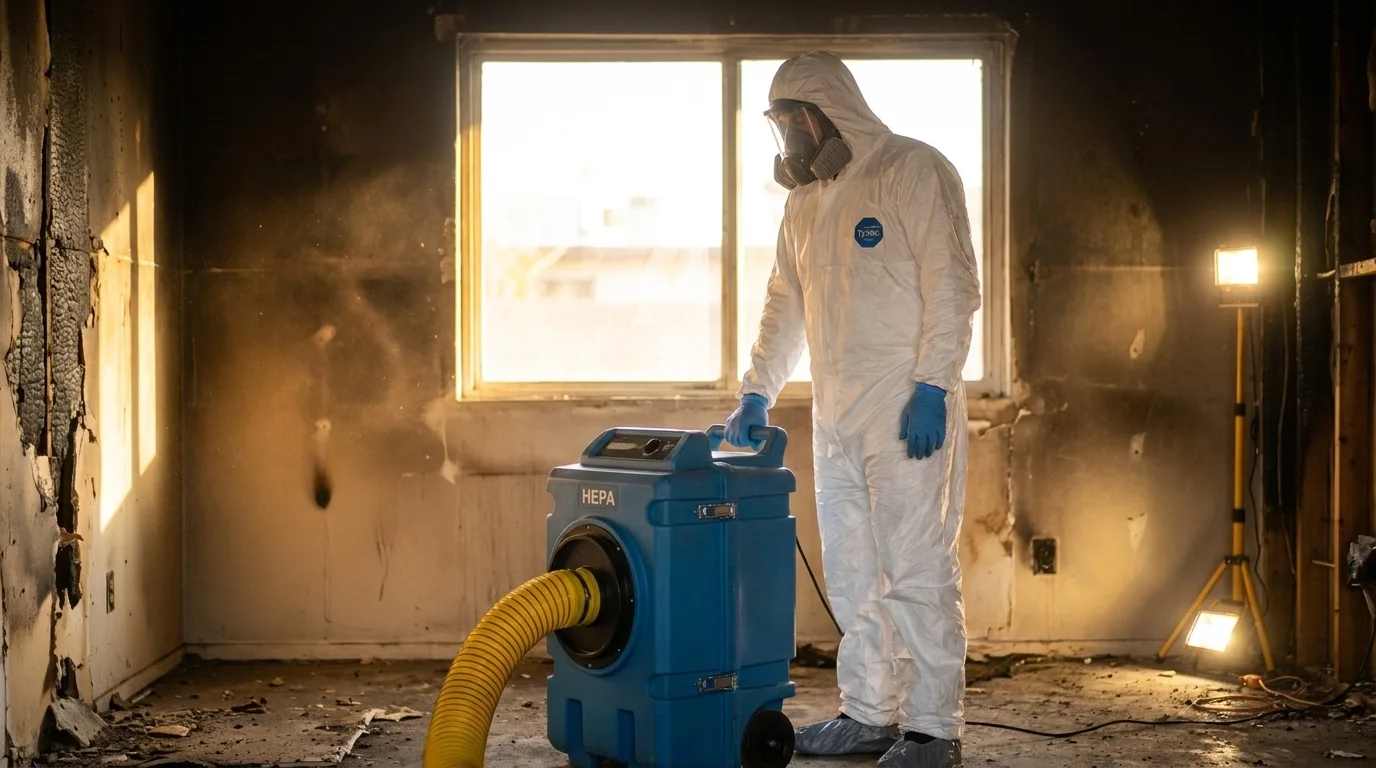
Equipment used in fire restoration includes hydroxyl generators and ozone machines for odor neutralization, thermal foggers that push deodorizing agents into the same pathways smoke traveled, HEPA air scrubbers to capture airborne particulates, and ultrasonic cleaning tanks for salvageable contents.
Our process
-
Emergency stabilization and safety assessment. Before any cleaning begins, the structure is evaluated for compromised load-bearing elements, broken glass, and electrical hazards. Board-up and roof tarping protect the property from weather and unauthorized entry while the scope is being developed.
-
Soot characterization and pre-cleaning. Technicians identify soot types in each affected zone, dry/wet/protein, and test cleaning agents on inconspicuous areas before committing to a method. Dry soot is vacuumed with HEPA equipment before any wet cleaning begins. This step is what separates a restorable surface from one that gets written off.
-
Contents pack-out and inventory. Salvageable belongings, furniture, clothing, documents, electronics, are inventoried, packed, and transported to a climate-controlled facility for cleaning and storage. This protects contents from ongoing smoke exposure during structural work and gives adjusters a documented inventory for the claim.
-
Structural cleaning, deodorization, and HVAC treatment. Wall cavities, attic spaces, and duct systems are cleaned and treated. Thermal fogging and hydroxyl generation run concurrently with structural drying if water suppression was used. Affected insulation is removed; drywall that cannot be cleaned to pre-loss condition is marked for replacement.
-
Clearance and reconstruction handoff. Once surfaces pass odor and contamination checks, the scope transitions to reconstruction, framing, drywall, painting, flooring, and finish work, so the homeowner receives a single point of contact from first response through move-back.
What separates a good fire response from a bad one
The most common failure in fire restoration is treating smoke damage as a cleaning problem rather than a chemistry problem. Painting over soot-stained walls without proper cleaning and sealing with an odor-blocking primer results in bleed-through and persistent smell within weeks. Replacing drywall without addressing smoke in the wall cavity behind it produces the same outcome.
A second common miss is the HVAC system. Smoke travels through return air ducts and coats coil surfaces, blower wheels, and ductwork throughout the home. Skipping duct cleaning means the first time the system runs after restoration, it redistributes smoke odor to every room, including rooms that were never affected.
Insurance adjusters look for a documented scope that matches the actual loss: soot type noted, affected square footage measured, contents inventoried with pre-loss values, and a drying log if water suppression was involved. A vague invoice without line-item documentation is the fastest way to a disputed claim.
What does Fire Damage Restoration cost?
Typical costs vary significantly based on fire size, soot type, and how far smoke migrated through the structure. Most homeowners pay somewhere between $3,500 and $40,000 for residential fire and smoke restoration, with contents pack-out, reconstruction, and HVAC cleaning adding to that range depending on the loss. Every fire loss is different, and Life Savers Restoration LLC provides a written scope of work before any billable work begins.
| Scenario | Typical industry range |
|---|---|
| Small kitchen fire, limited to one room | $3,500 – $8,000 |
| Single-room structural fire with smoke spread | $8,000 – $18,000 |
| Multi-room fire with contents pack-out | $15,000 – $35,000 |
| Whole-home fire with partial reconstruction | $35,000 – $80,000+ |
| Smoke-only damage, no structural loss | $2,500 – $7,000 |
| HVAC system decontamination (standalone) | $800 – $2,500 |
Homeowners insurance typically covers fire and smoke restoration, including contents pack-out and temporary housing, when the fire was accidental, though coverage limits, deductibles, and exclusions vary by policy.
Seasonal and regional considerations
The Mojave Desert climate affects fire restoration in ways that aren’t obvious. Henderson’s low humidity, often below 20% in summer, accelerates the drying of soot residue and causes it to bond more aggressively to painted surfaces and porous stone. That same dry air speeds structural drying after suppression, which is an advantage, but it also means smoke odor compounds volatilize quickly and penetrate deeper into materials before they can be treated. Homes built in Henderson’s rapid-growth corridors from the 1990s onward often use synthetic stucco exteriors and engineered wood framing that respond differently to heat and smoke than older masonry construction, both affect how the structure is cleaned and what gets replaced versus restored.
Service area
Life Savers Restoration LLC is based in Henderson and responds to fire damage calls throughout the Las Vegas Valley, including Henderson, Las Vegas, North Las Vegas, Boulder City, Summerlin, and surrounding communities. City-specific pages cover local permitting and utility coordination for each area.
If your home or property has fire or smoke damage, the sooner soot treatment begins, the more surfaces, and contents, can be saved. Call (702) 845-1325 to begin smoke and soot removal and get a written scope before work starts.
Services We Handle
- Fire & Smoke Damage Restoration
- Fire & Smoke Restoration
- Fire and Smoke Damage Cleanup
- Fire Damage Cleanup
- Fire Damage Cleanup Repair
- Smoke/Soot Damage
- Soot Removal
Frequently Asked Questions
What's the difference between protein soot and synthetic soot, and why does it change how cleanup works?
Does homeowners insurance cover fire damage restoration?
How far does smoke damage typically spread beyond the room where the fire started?
What happens to my belongings during fire restoration — do they stay in the house?
Why does smoke smell come back after a restoration company said the job was done?
Looking for the best fire damage restoration company in Henderson?
Life Savers Restoration LLC provides licensed and insured fire damage restoration in Henderson, NV and the surrounding area, and has served local property owners since 2019. Customers rate us 4.8 out of 5 stars across 246 Google reviews. We answer calls 24/7 — call (702) 845-1325 for immediate help.
Need Fire Damage Restoration now?
We respond 24/7 across Henderson and surrounding NV cities.
Related Coverage
- Our Restoration Services
- Contact Life Savers Restoration LLC
- 24/7 Emergency Fire Damage Restoration in Boulder City
- 24/7 Emergency Fire Damage Restoration in Enterprise
- 24/7 Emergency Fire Damage Restoration in Las Vegas
- 24/7 Emergency Fire Damage Restoration in North Las Vegas
- 24/7 Emergency Fire Damage Restoration in Paradise
- 24/7 Emergency Fire Damage Restoration in Spring Valley
- 24/7 Emergency Fire Damage Restoration in Sunrise Manor
- 24/7 Emergency Fire Damage Restoration in Whitney
- How To Choose a Restoration Company in Henderson (Without Getting Burned)
- The Fire Damage Restoration Process, Explained