24/7 Emergency Storm Damage Restoration in Henderson
24/7 emergency storm damage restoration in Henderson and surrounding areas. IICRC-certified, insurance billing accepted. Call (702) 845-1325.
Storm damage emergency in Henderson? We answer 24/7. Call now and our crew heads out to secure the property and stop further damage.
A storm doesn’t announce how much damage it left behind. The roof takes the obvious hit, shingles stripped, a branch through the fascia, but the water that followed has already moved into the attic insulation, down the wall cavities, and under the subfloor before the rain stops. That hidden moisture is what turns a $4,000 repair into a $40,000 restoration if it’s missed in the first 48 to 72 hours. Storm damage restoration is the work of finding all of it, stopping the secondary damage, and rebuilding what can’t be saved.
What Storm Damage Restoration actually involves
Storm losses are layered. Wind peels back the building envelope, roofing, siding, windows, doors, and water exploits every gap. In the Mojave Desert climate around Henderson, the threat isn’t a prolonged rainy season; it’s the intensity of monsoon-season downpours hitting sun-baked, compacted soil that can’t absorb water fast enough. Flash flooding pushes debris-laden water into garages and ground-floor rooms. Microbursts drive rain horizontally under roof flashing and through soffit vents that were never designed to handle that angle of entry.
The work involves:
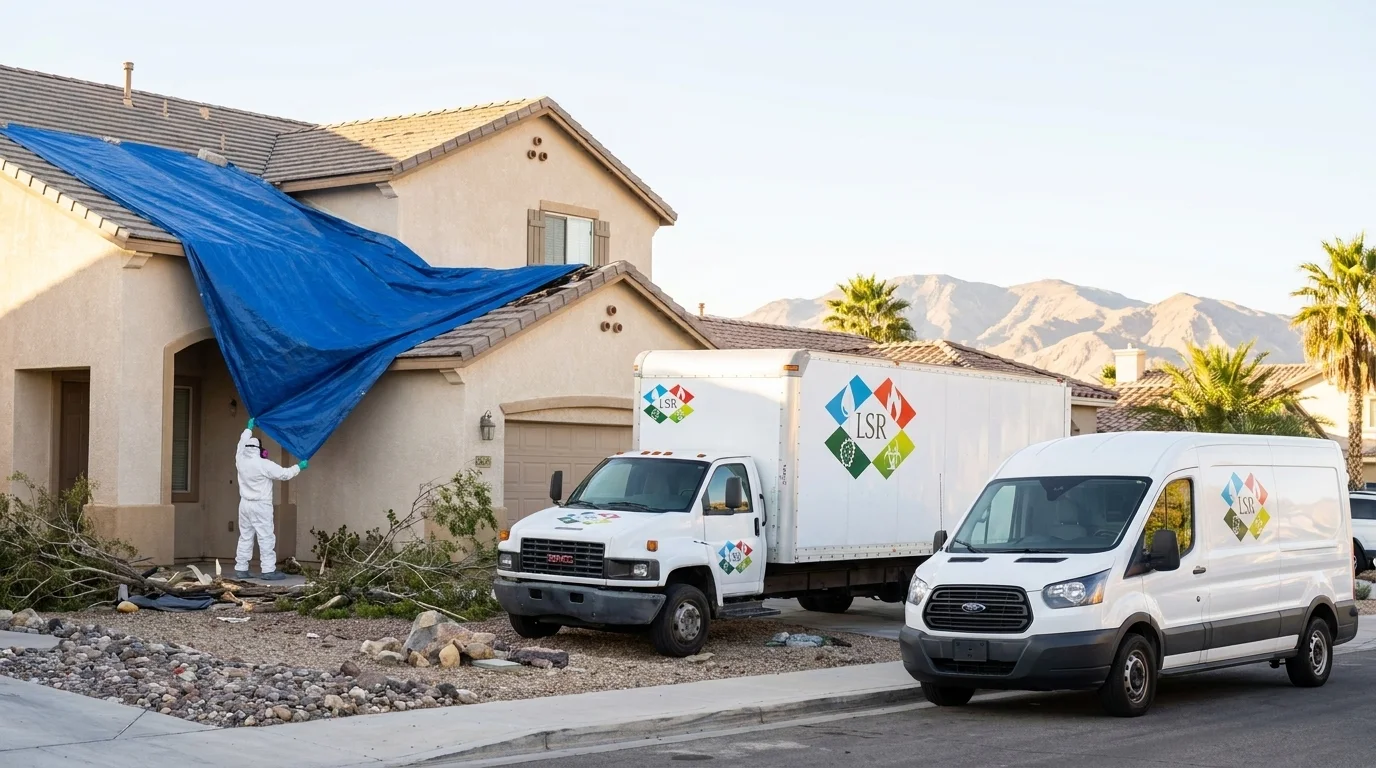
- Emergency tarping and board-up to close the building envelope before secondary rain events or wind cause additional loss
- Moisture mapping using thermal imaging cameras and penetrating moisture meters to trace where water traveled inside wall assemblies and flooring systems
- Structural drying with industrial air movers and refrigerant or desiccant dehumidifiers sized to the affected area, not residential box fans
- Debris removal and selective demolition of materials that are saturated beyond drying thresholds (typically drywall that has absorbed Category 1 water past the point of structural integrity, or any material touched by Category 3 floodwater)
- Reconstruction scoped to match existing materials, finishes, and code requirements
Timeline depends on the scope. Emergency stabilization happens in the first hours. Structural drying typically runs 3 to 5 days for contained water intrusion, longer when wall cavities or roof assemblies are involved. Reconstruction scheduling follows after the structure passes a dry standard.
Our process
-
Damage assessment and emergency stabilization. The crew walks the exterior and interior, documents every point of entry, and photographs the full loss for insurance purposes. If the roof or windows are open to weather, tarping and board-up happen before anything else.
-
Moisture mapping. Thermal imaging reveals temperature differentials behind walls and ceilings where water has wicked into framing or insulation. Penetrating meters confirm actual moisture content in wood and drywall. This step defines the true scope, not just what’s visibly wet, but what’s wet inside the assembly.
-
Selective demolition and debris removal. Materials that can’t be dried in place, saturated insulation, buckled flooring, drywall below the flood line, are removed and documented by category for the insurance claim. Structural framing is evaluated for integrity before drying equipment is placed.
-
Structural drying and monitoring. Air movers and dehumidifiers are positioned according to the drying plan, not just pointed at wet spots. Moisture readings are logged daily. Equipment is adjusted as materials dry to maintain efficient evaporation rates. Drying is complete when affected materials reach a dry standard consistent with IICRC S500 guidelines, not when the surface feels dry to the touch.
-
Reconstruction scoping and rebuild. Once the structure is dry and stable, a written scope of work covers framing repairs, insulation replacement, drywall, roofing, siding, and finish work. Permits are pulled where required by Clark County or the City of Henderson.
What separates a good storm damage response from a bad one
The most common mistake in storm damage work is treating the visible damage as the complete damage. A crew that patches the roof, pulls wet carpet, and sets a few fans has addressed the surface. What they’ve missed is the water that traveled 8 feet down a wall cavity and pooled on the top plate of the first floor, or the insulation in the attic that’s holding moisture against the roof sheathing.
Insurance adjusters increasingly use moisture logs and drying documentation to validate claims. A restoration company that can’t produce daily moisture readings, equipment placement records, and psychrometric data will have a harder time supporting a full scope of work with the carrier. Thorough documentation protects the homeowner as much as it protects the claim.
Other things that separate thorough storm restoration from a surface-level cleanup:
- Identifying wind-driven water that entered through soffit vents or ridge vents, not just obvious roof penetrations
- Recognizing when Category 1 rainwater has become Category 3 by contact with soil, sewage backup, or standing time beyond 72 hours
- Testing for pre-existing conditions (mold, asbestos, lead paint in older Henderson homes) before demolition begins, the EPA Lead-Safe certification the team holds matters here
- Distinguishing structural damage that requires a licensed contractor from cosmetic damage that doesn’t, and knowing when a structural engineer’s assessment is warranted
What does Storm Damage Restoration cost?
Typical costs for storm damage restoration vary widely depending on how much of the building envelope was breached, how far water traveled, and what materials need replacement. Most homeowners pay somewhere in the ranges below, these are industry-typical figures, not quotes.
| Scenario | Typical range |
|---|---|
| Emergency tarping and board-up only | $300 – $1,500 |
| Roof leak with limited attic intrusion, no drywall damage | $1,500 – $4,500 |
| Single room water intrusion, drying and drywall replacement | $2,500 – $7,000 |
| Multi-room wind and water damage, partial roof loss | $8,000 – $25,000 |
| Significant structural damage with full reconstruction | $25,000 – $80,000+ |
| Flash flood with Category 3 water, full gut and rebuild | $40,000 – $100,000+ |
Every loss is different, and Life Savers Restoration LLC provides a written scope of work before any restoration begins so there are no surprises. Homeowners insurance typically covers sudden and accidental storm damage, wind, hail, lightning, and resulting water intrusion, though flood damage from rising groundwater usually requires a separate NFIP or private flood policy.
Seasonal and regional considerations
Henderson and the broader Las Vegas Valley sit in a desert climate that produces storm damage in patterns most homeowners don’t expect. The North American Monsoon brings intense thunderstorms from roughly July through September. These storms can drop an inch of rain in under an hour on soil that’s spent months baking dry, the result is rapid surface runoff, flash flooding in low-lying streets, and water entering homes through window wells, garage doors, and any gap in the foundation stem wall.
Winter brings a different risk: occasional freezing temperatures at higher elevations in the valley can cause pipe bursts that compound roof or window damage from wind events. Homes built before the mid-1990s in Henderson’s older neighborhoods often have original single-pane windows and aging roof flashing that performs poorly under wind-driven rain.
High winds, particularly the Santa Ana-influenced gusts that move through the valley in fall and spring, can exceed 60 mph and are responsible for most of the tree-on-structure damage and fence collapses that follow storms in this area.
Service area
Life Savers Restoration LLC is based in Henderson and responds to storm damage throughout the Las Vegas Valley, including Henderson, Las Vegas, North Las Vegas, Boulder City, Summerlin, and the surrounding unincorporated communities of Clark County. Individual city service pages go deeper on local housing stock, permit contacts, and neighborhood-specific considerations.
If a storm has left your roof open, your walls wet, or your floors buckled, the clock on secondary damage is already running. Call Life Savers Restoration LLC at (702) 845-1325 to schedule your storm damage assessment, the sooner moisture is mapped and the building envelope is closed, the more of your home and your claim can be saved.
Services We Handle
- Emergency Board Up
- Emergency Storm Damage Repair
- Emergency Tarping
- Hurricane Damage Restoration
- Roof Leak Water Damage
- Roof Leaks
- Storm & Wind Damage Restoration
- Wind Damage Repair
- Wind Damage Restoration
Frequently Asked Questions
Does homeowners insurance cover storm damage restoration?
How do I know if my roof damage caused hidden water damage inside the walls or attic?
What's the difference between wind damage and flood damage, and why does it matter for my claim?
When does storm-related water intrusion become a Category 3 hazard?
What should I do to protect my home while waiting for the restoration crew to arrive?
Looking for the best storm damage restoration company in Henderson?
Life Savers Restoration LLC provides licensed and insured storm damage restoration in Henderson, NV and the surrounding area, and has served local property owners since 2019. Customers rate us 4.8 out of 5 stars across 246 Google reviews. We answer calls 24/7 — call (702) 845-1325 for immediate help.
Need Storm Damage Restoration now?
We respond 24/7 across Henderson and surrounding NV cities.
Related Coverage
- Our Restoration Services
- Contact Life Savers Restoration LLC
- 24/7 Emergency Storm Damage Restoration in Boulder City
- 24/7 Emergency Storm Damage Restoration in Enterprise
- 24/7 Emergency Storm Damage Restoration in Las Vegas
- 24/7 Emergency Storm Damage Restoration in North Las Vegas
- 24/7 Emergency Storm Damage Restoration in Paradise
- 24/7 Emergency Storm Damage Restoration in Spring Valley
- 24/7 Emergency Storm Damage Restoration in Sunrise Manor
- 24/7 Emergency Storm Damage Restoration in Whitney