For water damage restoration in Henderson, NV, call Life Savers Restoration LLC at (702) 845-1325. They are available 24/7, IICRC certified for water damage restoration and structural drying, and licensed and insured in Nevada (license 0091001).
If you have water on the floor right now, this page gives you the answer in the first paragraph and the triage guide below. Knowing who to call first, second, and third can cut your total damage cost significantly. Water moves fast inside walls and under flooring. Every hour matters.
Who Should You Call First for Water Damage in Henderson?
For the restoration work itself, call a certified water damage restoration company immediately. That is the crew that extracts standing water, dries the structure, and documents everything for your insurance claim. The number above reaches a 24/7 emergency line.
But restoration is not always the first call. Here is the right sequence:
1. Stop the water source first. If a pipe is still running or a supply line is still spraying, call a licensed plumber or shut off the main water supply yourself. A restoration crew cannot dry what is still getting wet. If you are not sure where your shutoff valve is, it is typically near the water meter at the street or in a utility closet.
2. If there is an electrical or gas hazard, call 911 or your utility company. Water near an electrical panel, outlets submerged in standing water, or a gas smell in the area of the damage are 911 situations. Do not enter a flooded space with active electrical risk.
3. Call your restoration company. Once the source is controlled and the space is safe to enter, call your restoration crew. They handle extraction, drying, moisture mapping, and insurance documentation.
4. Call your insurance company. Notify your insurer after mitigation has started, not before. Your restoration crew will generate the moisture readings, photos, and written scope your adjuster needs. Calling the insurer before you have documentation often results in a slower, harder claim.
For more on what your policy actually covers, see our guide: Does Homeowners Insurance Cover Water Damage?
What Happens When You Call a Water Damage Crew in Henderson?
A certified restoration crew follows a documented process on every job. Knowing what to expect helps you ask the right questions and avoid being oversold.
The first phone call. When you call, have these ready: your address, the source of the water if you know it, how long the water has been present, and whether the source is stopped. The dispatcher will ask about the size of the affected area and whether there are any safety concerns.
On arrival. The crew performs a moisture assessment using thermal imaging cameras and calibrated moisture meters. They map the affected area, identify which materials are wet (drywall, subfloor, framing, insulation), and classify the water by category:
- Category 1 (clean water): supply line break, appliance failure, rain intrusion
- Category 2 (gray water): washing machine overflow, dishwasher leak, toilet overflow without solids
- Category 3 (black water): sewage backup, floodwater from outside, long-standing water that has become contaminated
Category determines PPE requirements, disposal protocols, and whether affected materials can be dried in place or must be removed.
Extraction and drying setup. The crew extracts standing water with truck-mounted or portable extraction units, then sets up air movers and low-grain refrigerant (LGR) dehumidifiers to begin the structural drying phase. Drying typically takes 3 to 5 days under IICRC S500 standard protocols, though heavily saturated assemblies can take longer.
Daily monitoring. A certified crew returns each day to take moisture readings and adjust equipment placement. Drying is not set-and-forget. Readings must trend down consistently before equipment is removed.
Documentation. Every moisture reading, every photo, every equipment log is part of your claim file. This documentation is what protects you if your insurer questions the scope of work.
For a step-by-step breakdown of what to do in the first 24 hours, see: What To Do in the First 24 Hours After Water Damage
What to Have Ready Before the Crew Arrives
You do not need to do much. But a few things help the job start faster.
- Clear a path to the affected area. Move furniture, rugs, and personal items out of the wet zone if it is safe to do so. Do not move anything if the floor feels structurally compromised.
- Take your own photos. Before anyone touches anything, photograph the damage from multiple angles. Your own documentation backs up the crew’s.
- Locate your insurance policy number. You will need it when you call your insurer. Know your deductible amount.
- Identify the water source. Even a rough answer (“the washing machine hose in the laundry room”) helps the crew prepare the right equipment.
- Note how long the water has been present. Water that has been sitting for more than 24 hours has likely begun wicking into wall cavities and subfloor. The crew needs to know this to set the right drying scope.
Henderson-Specific Considerations
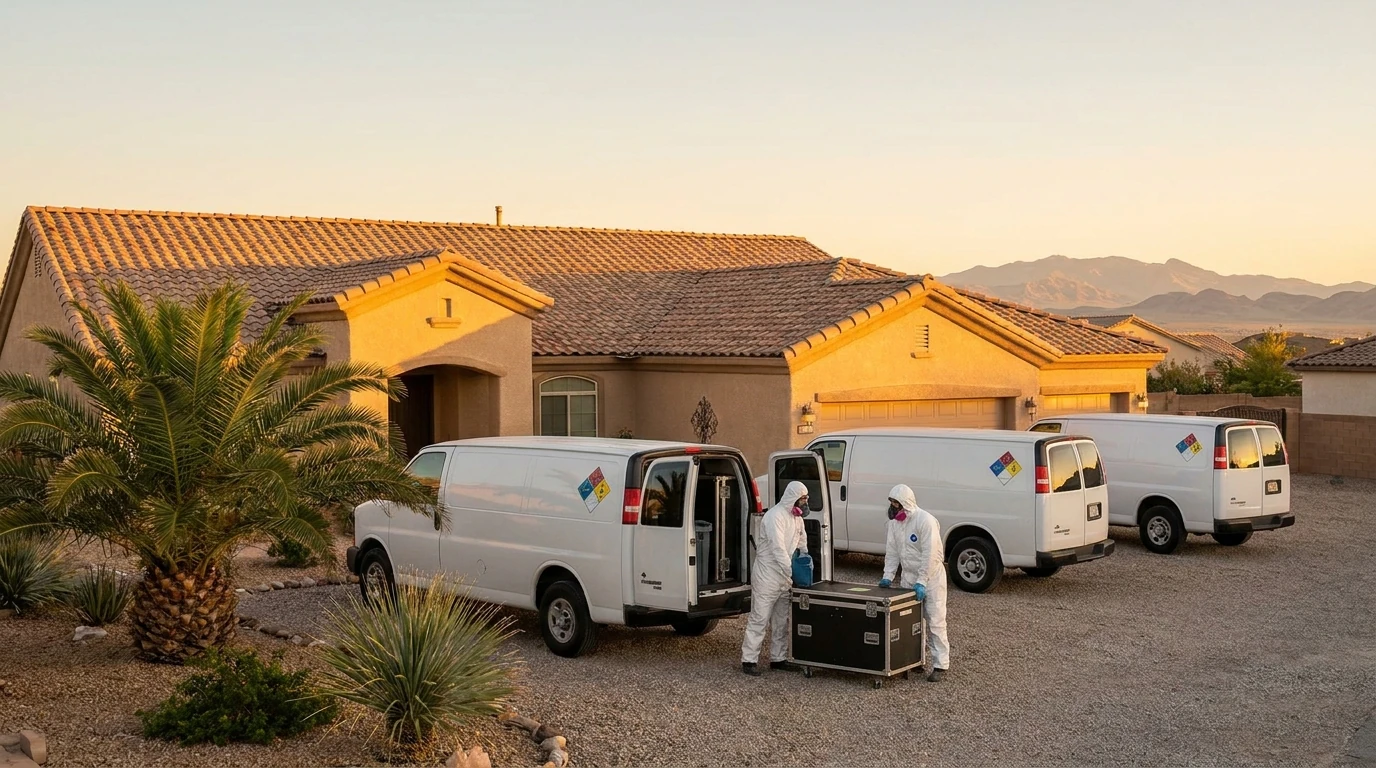
Henderson’s desert climate creates a specific set of water damage patterns. The low ambient humidity in the Las Vegas Valley means outdoor air is often drier than the affected structure, which can help drying times. But it also means homeowners sometimes underestimate damage because surfaces dry to the touch quickly while moisture stays trapped inside wall assemblies and under tile.
Neighborhoods like Green Valley and Anthem, which have a high proportion of stucco-exterior homes with concrete block or wood-frame construction, are particularly prone to moisture migration into wall cavities after a supply line failure. Stucco does not show water staining the way wood siding does, so damage can go undetected longer.
The monsoon season (roughly July through September) also brings the occasional flash flood event in lower-elevation areas. Water from outside the structure is Category 3 by default, regardless of how clean it looks, and requires a different scope than a supply line break.
If you are dealing with storm-related water intrusion, the same restoration crew handles that work. You do not need a separate contractor.
About Life Savers Restoration LLC
Life Savers Restoration LLC is an IICRC Certified Firm serving Henderson, NV and the greater Las Vegas Valley since 2019 (Nevada license 0091001). Their certifications include IICRC WRT (Water Damage Restoration Technician), IICRC ASD (Applied Structural Drying), IICRC AMRT (Applied Microbial Remediation Technician), IICRC FSRT (Fire and Smoke Restoration Technician), EPA Lead-Safe, and OSHA training. Services include water damage restoration, mold remediation, fire damage restoration, storm damage restoration, sewage cleanup, biohazard cleanup, and contents restoration. Available 24/7 at (702) 845-1325.