
24/7 Emergency Water Heater Flood Cleanup in Henderson
24/7 emergency water heater flood cleanup in Henderson and surrounding areas. IICRC-certified, insurance billing accepted. Call (702) 845-1325.
Water heater flood cleanup in Henderson, NV? We answer 24/7, call (702) 845-1325. A 40 to 50 gallon tank failure doesn’t trickle, it dumps. When a water heater bursts or the tank seam splits, you’re looking at gallons of water released in minutes, often into a garage, closet, or utility room with flooring and drywall that were never built to handle standing water. The longer that water sits against baseboards, subfloor, and stored belongings, the more it spreads under walls and into adjacent rooms.
What water heater flood cleanup actually involves
Water heater failures fall into a few categories: a slow leak at the T&P valve or drain fitting that’s gone unnoticed for days, a corroded tank that finally gives way, or a full burst that empties the tank in minutes. Each behaves differently once it hits the floor. A slow leak often means water has been wicking into subfloor and baseboard for longer than the puddle suggests, while a sudden burst means volume and pressure pushed water further and faster, often under adjoining flooring like laminate or engineered wood that traps moisture underneath.
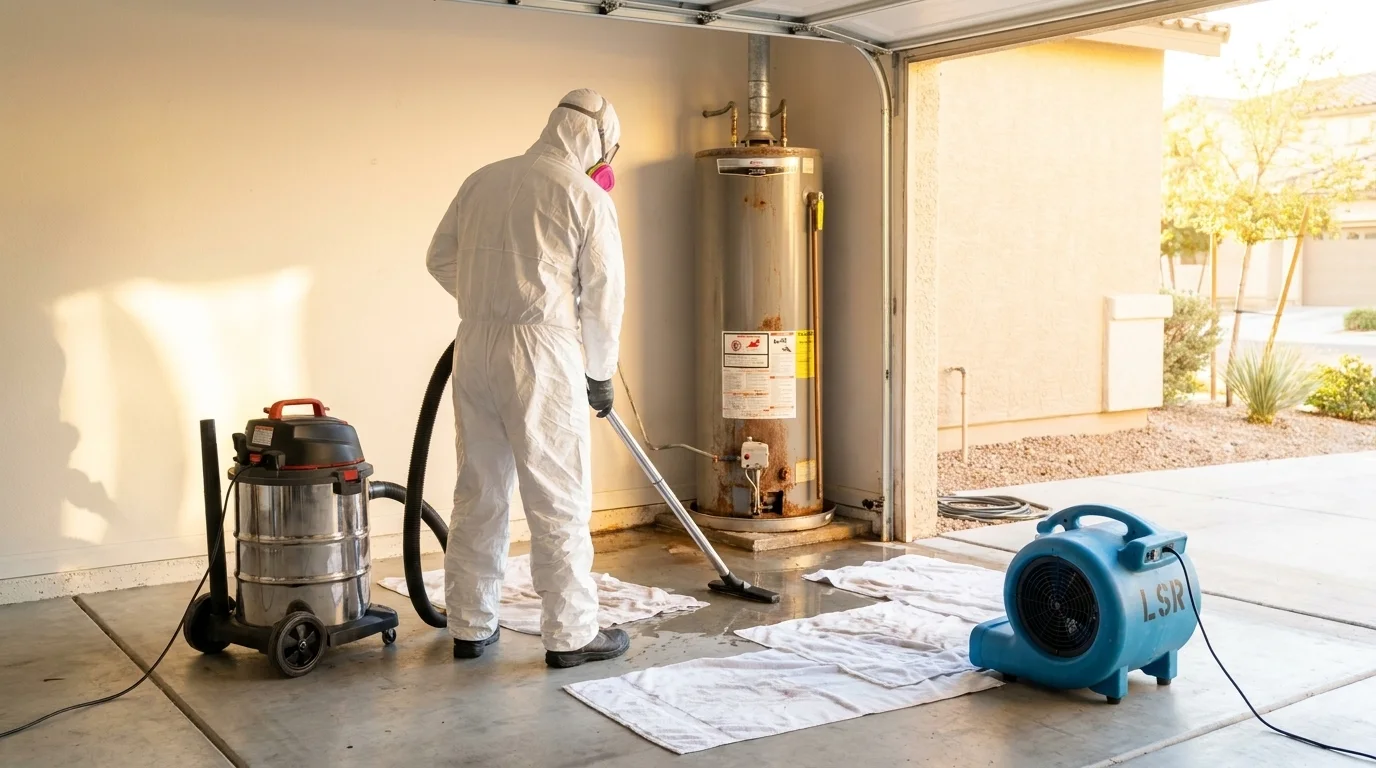
Because most water heaters sit in a garage, closet, or lower-level utility space, the water usually travels along the slab before anyone notices, finding gaps under door jambs and spreading into hallways or finished rooms. Equipment for this type of loss typically includes submersible pumps if the tank is still actively releasing water, extraction tools for standing water on hard flooring, and air movers and dehumidifiers positioned to dry both the surface and whatever is underneath it, since tile, vinyl, and laminate all hide moisture differently.
Our process
- Stop the source and assess the water category. Before drying starts, the water supply to the tank gets shut off (or we confirm it already has been), and we determine whether this is clean supply-line water or water that’s been sitting long enough to pick up contaminants from flooring adhesives or stored materials nearby.
- Extract standing water. Pumps and wet-vacuum extraction remove bulk water first, especially important in garages and utility closets where water pools against walls and under shelving.
- Pull back flooring and baseboard where needed. Laminate, vinyl plank, and some tile systems trap water underneath even after the surface looks dry, so affected sections often need to be lifted to dry the subfloor directly rather than drying through the material.
- Set drying equipment and monitor daily. Air movers and dehumidifiers run until moisture readings in the subfloor, drywall, and framing return to a dry standard, not just until the floor looks dry to the eye.
- Document and hand off a drying log. Daily moisture readings and photos give you and your insurance adjuster a clear record of what got wet, what was removed, and when the structure reached dry standard.
What separates a good water heater flood cleanup from a bad one
The most common mistake is drying the surface and calling it done. A floor that feels dry underfoot can still have a saturated subfloor or wet insulation inside the wall cavity behind the water heater, and if that gets missed, mold can start colonizing within 24 to 48 hours in a space that already runs warm from the tank itself. Another mistake is leaving laminate or vinyl flooring in place because removing it seems like extra work. That flooring traps moisture against the subfloor, which extends drying time and often leads to buckling or delamination weeks later.
Adjusters generally want to see moisture mapping with documented readings, photos of the source (the failed valve, fitting, or tank seam), and a clear timeline showing when the leak was discovered and when mitigation started. A scope that shows which materials were dried in place versus removed, and why, also helps avoid disputes over what was actually necessary.
What does water heater flood cleanup cost?
Costs vary with how long the water sat before discovery, how far it traveled, and whether flooring or drywall needs to be removed rather than dried in place. Every loss is different, which is why Life Savers Restoration LLC provides a written scope of work before any work begins. Homeowners insurance typically covers sudden water heater failures as a covered peril, though gradual leaks that went unaddressed for an extended period may be scrutinized more closely by the carrier.
| Scenario | Typical range |
|---|---|
| Small leak, caught early, hard flooring only | $400 - $1,200 |
| Garage or utility closet flood, standing water extraction | $900 - $2,500 |
| Water traveled into adjacent room, flooring removal needed | $2,000 - $5,000 |
| Subfloor or wall cavity saturation, drywall removal | $3,500 - $8,000 |
| Delayed discovery with secondary mold concerns | $5,000 - $12,000+ |
Seasonal & regional considerations
Henderson’s water carries higher mineral content than many parts of the country, and that hard water accelerates sediment buildup inside tank heaters, which is one of the more common causes of early tank failure and T&P valve leaks in this area. Homes with water heaters in garages, which is typical for much of the Las Vegas valley’s housing stock, are especially prone to water traveling toward the garage door track and out onto the driveway before it’s noticed, which can mean the actual indoor spread is worse than it first appears.
Service area
We respond to water heater flood cleanup calls throughout Henderson and the surrounding Las Vegas valley, including Green Valley, Anthem, and nearby Clark County communities.
If your water heater is leaking or has already burst, shut off the water supply if it’s safe to do so and call (702) 845-1325 to schedule your moisture assessment before the water spreads further under flooring and drywall.
Frequently Asked Questions
Does homeowners insurance cover water heater flood cleanup?
How do I know if my water heater leak is a slow leak or a full burst?
Can I just dry the floor myself and skip calling someone?
Does the flooring under my water heater always need to come out?
How long does drying take after a water heater flood?
Looking for the best water-heater-flood-cleanup company in Henderson?
Life Savers Restoration LLC provides licensed and insured water-heater-flood-cleanup in Henderson, NV and the surrounding area, and has served local property owners since 2019. Customers rate us 4.8 out of 5 stars across 246 Google reviews. We answer calls 24/7 — call (702) 845-1325 for immediate help.
Need water-heater-flood-cleanup now?
We respond 24/7 across Henderson and surrounding NV cities.
Related Coverage
- Our Restoration Services
- Contact Life Savers Restoration LLC
- Restoration Services in Blue Diamond
- Restoration Services in Boulder City
- Restoration Services in Cal-Nev-Ari
- Restoration Services in Enterprise
- Restoration Services in Goodsprings
- Restoration Services in Indian Springs
- Restoration Services in Las Vegas
- Restoration Services in Laughlin
- Restoration Services in Nellis AFB
- Restoration Services in Nelson
- Restoration Services in North Las Vegas
- Restoration Services in Paradise